

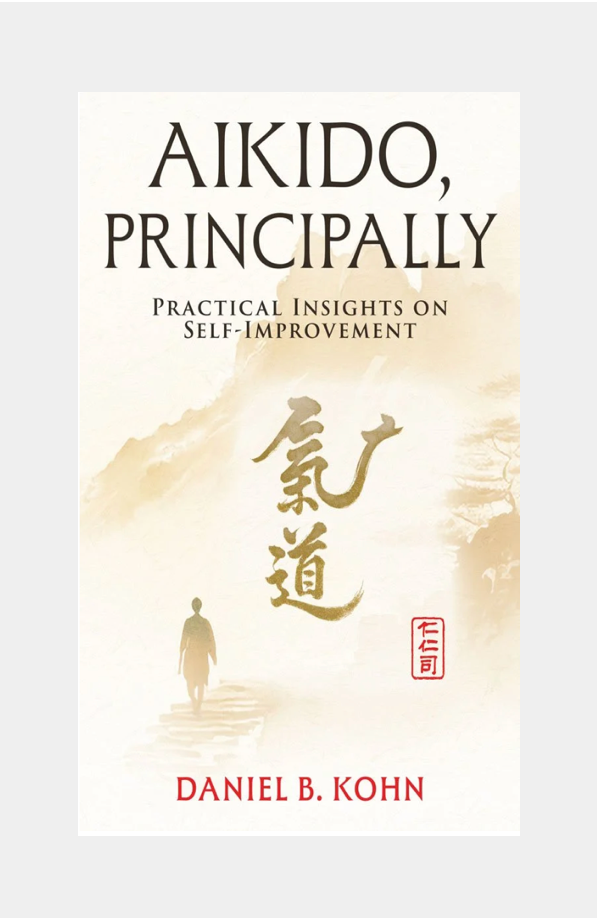

After nearly four decades on the Aikido mat, Daniel Kohn noticed something: the techniques get taught, but the principles underneath them rarely do. Aikido, Principally is his attempt to close that gap — a field guide to the secondary wisdom that surfaces in seminars, in a sensei's offhand comment, in the quiet aha moment mid-fall.
Organized around traditional Japanese Aikido concepts — Kokyu (breath power), Ki (energy), Kuzushi (balance), Mushin (an unclouded mind), and more — the book breaks each into short, standalone reflections built from Kohn's own training: sixteen years of Tai Chi, decades across Japanese and American dojos, and a rabbi's instinct for finding the sacred in the ordinary. The result is less a martial arts manual than a collection of hard-earned aha moments — on staying centered under pressure, welcoming conflict instead of resisting it, and letting go of the need to win.
Readers don't need to have set foot on a mat to find something here. Kohn writes for anyone drawn to the idea that how we move through resistance — physical or otherwise — says something about how we move through life. Funny, personal, and refreshingly unpolished in its honesty, Aikido, Principally offers over a hundred of these principles as a living, evolving practice rather than a finished philosophy — an invitation, as Kohn puts it, to become "a little further along this beautiful, confounding, ever-unfolding path."